Central Johnson County, KS has opened for sign-ups today. This includes Merriam, KS, part of Shawnee and part of Lenexa, KS. Deadline to signup for Central Johnson County is October 30th.
Johnson County Northeast which includes Westwood, Westwood Hills, Mission Woods and Roeland Park is getting close to the end of their pre-registration period. September 12th is the deadline for Johnson County Northeast.
All of the fiberhoods in Central Johnson County met their goal!
Tuesday, August 26, 2014

Saturday, July 12, 2014
Google Fiber - "What speed do you really get?"
I've heard the question "What speed do you really get?" a lot since I've had Google Fiber installed. I thought I would show a few examples and explain why some of them might be misleading.
*All of these examples were taken wired in, to take wireless out of the equation.
First, a speedtest to Google Fiber's KC speedtest server. (kansas.speedtest.googlefiber.net) ~1 ms away
 This is close to the best speeds you'll ever see. 941 Mbps down and 941 Mbps up is pretty much the max, the rest (~60 Mbps in each direction) is protocol overhead. If you want to understand why there is so much protocol overhead this is an excellent article that explains it. Protocol Overhead by Phil Dykstra
Next is a speedtest to Google Fiber's Mountain View speedtest server. (speed.googlefiber.net) ~40 ms away
 Something seems odd here, why is the download so much slower than the upload?
The Google Fiber speedtest uses a different method to test download then it uses to test upload. The method they use to test download works fine with very low latency but does pretty bad at just 40ms of latency. The upload speed still looks great though.
Here's the speedtest to Google Fiber's Provo speedtest server. (provo.speedtest.googlefiber.net) ~23 ms away
 At 23ms away the download speed went up a little but it's lower than the true speed still. Upload looks great.
In case you don't trust Google Fiber's own speedtest, here's what speedtest.net looks like. (Disclaimer: Google setup their own speedtest server for speedtest.net. It can only be used by Google Fiber customers.)
 Google had to setup their own server because most test servers on speedtest.net can't handle testing a Gigabit connection.
The ~800 Mbps download is odd because the exact same servers that are used for speedtest.googlefiber.net are used as speedtest servers for speedtest.net. Both speedtests were written by Ookla and use the same ports and test data.
It appears the flash speedtest that Google uses handles minor hiccups during the test much better than speedtest.net's flash speedtest does though.
My conclusion is that Google Fiber really does provide 1 Gbps down and up. Speedtests just aren't great at showing connections of that speed yet, especially over any distance.
**If you have an older computer, even if it has a gigabit network card, you won't be able to reach the max speed that Google Fiber offers with flash speedtests.
UPDATE 8-17-2014:
It looks like tweaks have been made to the speedtest servers. Here are new results as of 8-17-2014:

KC Speedtest


Mountain View Speedtest
Note: speed.googlefiber.net no longer points to the Mountain View speedtest server, use this link instead spd101.nuq1.googlefiber.net
Provo Speedtest

KC Speedtest.net
*All of these examples were taken wired in, to take wireless out of the equation.
First, a speedtest to Google Fiber's KC speedtest server. (kansas.speedtest.googlefiber.net) ~1 ms away
Next is a speedtest to Google Fiber's Mountain View speedtest server. (speed.googlefiber.net) ~40 ms away
The Google Fiber speedtest uses a different method to test download then it uses to test upload. The method they use to test download works fine with very low latency but does pretty bad at just 40ms of latency. The upload speed still looks great though.
Here's the speedtest to Google Fiber's Provo speedtest server. (provo.speedtest.googlefiber.net) ~23 ms away
In case you don't trust Google Fiber's own speedtest, here's what speedtest.net looks like. (Disclaimer: Google setup their own speedtest server for speedtest.net. It can only be used by Google Fiber customers.)
The ~800 Mbps download is odd because the exact same servers that are used for speedtest.googlefiber.net are used as speedtest servers for speedtest.net. Both speedtests were written by Ookla and use the same ports and test data.
It appears the flash speedtest that Google uses handles minor hiccups during the test much better than speedtest.net's flash speedtest does though.
My conclusion is that Google Fiber really does provide 1 Gbps down and up. Speedtests just aren't great at showing connections of that speed yet, especially over any distance.
**If you have an older computer, even if it has a gigabit network card, you won't be able to reach the max speed that Google Fiber offers with flash speedtests.
UPDATE 8-17-2014:
It looks like tweaks have been made to the speedtest servers. Here are new results as of 8-17-2014:
KC Speedtest
Mountain View Speedtest
Note: speed.googlefiber.net no longer points to the Mountain View speedtest server, use this link instead spd101.nuq1.googlefiber.net
Provo Speedtest
KC Speedtest.net
Sunday, March 16, 2014
Google Fiber - Phase II Fiberhood
I went to check out a fiberhood under construction in phase II for KC since I heard they were using different vaults this time.
Looks like they moved away from the NewBasis polymer concrete enclosures to Channell Corp thermoplastic enclosures. Grade Level Boxes (GLB®) for Broadband and Telecommunications
It may be hard to see but they were ordered with the green cover, no logo, stainless steel L-bolt on the large vault and plastic L-bolt on the small vault.
 New large vault (Maybe not the best example for a picture - the rest I saw were placed with more care.)
 New small vault
 LCP with new thermoplastic vault.
This is the same Clearfield FieldSmart Fiber Scalability Center Cabinet that was used before.
 The inside of a newly installed LCP. (Before the cassettes and fiber have been installed.)
The splitters are 1:16. This cabinet has 48 distribution fibers coming in that can feed 288 homes (aka access fibers).
Update 4/19/2015:
 Outside view of new NID. Not sure if this replaces the old NID or if both are in use now.
Old NID OptiNID 300 DM000795
New NID 3M NID NID-FO-2724
 Inside view of new NID before fiber has been spliced to the pigtail.
(i.e. first step of fiber being installed at a house)
Second step - fiber sliced inside the NID is shown on an older blog post here.
Update 5/21/2015:
Google Fiber is going back and replacing some (if not all) of thermoplastic vaults because of issues with vehicles parking on them and causing damage. New areas may be installed with only the polymer concrete vaults.
Looks like they moved away from the NewBasis polymer concrete enclosures to Channell Corp thermoplastic enclosures. Grade Level Boxes (GLB®) for Broadband and Telecommunications
It may be hard to see but they were ordered with the green cover, no logo, stainless steel L-bolt on the large vault and plastic L-bolt on the small vault.
This is the same Clearfield FieldSmart Fiber Scalability Center Cabinet that was used before.
The splitters are 1:16. This cabinet has 48 distribution fibers coming in that can feed 288 homes (aka access fibers).
Update 4/19/2015:
Old NID OptiNID 300 DM000795
New NID 3M NID NID-FO-2724
(i.e. first step of fiber being installed at a house)
Second step - fiber sliced inside the NID is shown on an older blog post here.
Update 5/21/2015:
Google Fiber is going back and replacing some (if not all) of thermoplastic vaults because of issues with vehicles parking on them and causing damage. New areas may be installed with only the polymer concrete vaults.
Thursday, March 6, 2014
Google Fiber Kansas City Phase II Pre-registration Beginning
Phase II pre-registration will start on March 11th, 2014.
Cities included are:
Kansas City, North
South Kansas City, Mo
Gladstone
Grandview
Raytown
Deadlines to signup:
Sunday, April 14 — deadline for residents in 76 fiberhoods in south KCMO, Grandview & Raytown
(Closed for registration now - all but two made it!)
Thursday, May 15 — deadline for residents in 34 fiberhoods in KCMO northwest
(Closed for registration now - all but one made it!)
Monday, June 19 — deadline for residents in 52 fiberhoods in KCMO northeast and Gladstone plus 17 fiberhoods in Central KCMO and 4 fiberhoods in KCK that didn't meet their goals the first time!
All KCMO northeast fiberhoods qualified and 8 fiberhoods in Central KCMO qualified!
Map of cities in the KC metro area that have been announced officially for all phases:
http://goo.gl/maps/nDSlf
Phase III (by process of elimination - 2014):
Fairway, Kan.
Leawood, Kan.
Lenexa, Kan.
Merriam, Kan.
Mission Hills, Kan.
Mission Woods, Kan.
Mission, Kan.
Olathe, Kan.
Prairie Village, Kan.
Roeland Park, Kan.
Shawnee, Kan.
Westwood Hills, Kan.
Westwood, Kan.
Phase IV (2015)
Lee's Summit, Mo
Phase IV+? (Cities that will probably be included someday but not announced yet):
Blue Springs
Independence
Liberty
North Kansas City (The city)
Overland Park
Platte City
Pleasant Valley
Cities included are:
Kansas City, North
South Kansas City, Mo
Gladstone
Grandview
Raytown
Deadlines to signup:
(Closed for registration now - all but two made it!)
(Closed for registration now - all but one made it!)
All KCMO northeast fiberhoods qualified and 8 fiberhoods in Central KCMO qualified!
Map of cities in the KC metro area that have been announced officially for all phases:
http://goo.gl/maps/nDSlf
Phase III (by process of elimination - 2014):
Fairway, Kan.
Leawood, Kan.
Lenexa, Kan.
Merriam, Kan.
Mission Hills, Kan.
Mission Woods, Kan.
Mission, Kan.
Olathe, Kan.
Prairie Village, Kan.
Roeland Park, Kan.
Shawnee, Kan.
Westwood Hills, Kan.
Westwood, Kan.
Phase IV (2015)
Lee's Summit, Mo
Phase IV+? (Cities that will probably be included someday but not announced yet):
Blue Springs
Independence
Liberty
North Kansas City (The city)
Overland Park
Platte City
Pleasant Valley
Sunday, October 27, 2013
Google Fiber Beyond CPE
Ever since I saw the first Google Fiber hut I wondered what equipment was running everything and how it was all setup. I'm going to give you what my best guess is and maybe some day I'll get a chance to figure out if I was right or not. (So far Google has been very secretive about exactly how their network is built.)
 Since all the CPE equipment was custom designed my first thought was that maybe all the equipment in the fiber huts was also custom designed. That doesn't make a lot of sense though, the only reason the CPE equipment was custom designed was that nothing existed that met their needs at the right price point. There is equipment that would meet Google's needs for the fiber huts though. At least there's hardware that could meet their needs. That got me thinking, what hardware would Google choose for the job? Who makes the best access router that could handle the amount of bandwidth they plan on having?
That's when I found Juniper's MX2010 and MX2020.
If you've never heard of either of those access routers take a look at the spec sheet for the MX2020.
It's a monster sized router, designed to eventually scale to 80 Terabits per chassis! With room for 960 Ten Gigabit ports and plenty of bandwidth left to send all of that traffic upstream. If I had a way to know how many waves are on each fiber going back to the fiber hut then I would be able to guess the modules in use for customers (remember Google Fiber uses WDM-PON). It's either 10GE split into 8 waves or 40GE split into 32 waves. I'm leaning toward 10GE split into 8 waves, which would give one MX2020 the capacity to serve 7680 Gigabit customers. I'm guessing the links from the huts to the rest of their network are aggregates of 100GE links. Maybe a couple 4x100GE to start with. That would give an over-subscription of less than 10:1 for a fully loaded MX2020.
I also wondered about what the network might look like further upstream from the huts. Through a lot of trace-routes this is what I think the network looks like.
There appears to be five sites in KC (I'm assuming these are a layer up from the fiber huts since there should be a lot more sites if each one was a fiber hut.) MCI101, MCI102, MCI103, MCI104 and MCI105. MCI101 and MCI102 both have a single access router in them. While MCI103 has two distribution routers and one peering router. MCI104 and MCI105 both have a broadband network gateway (these are what actually connect back to the fiber huts). I attempted to map KC and the sites used for most upstream connectivity. (There's a lot more to map but I'll finish creating it later.)

Thursday, May 9, 2013
Google Fiber Install Continued
I finally got around to taking pictures of some more stages of a Google Fiber install in a new construction neighborhood.
 Trenches going into a large vault.
 Trenches with fiber in them.

Google Fiber Drop on the side of a house (before installation of the Fiber Jack.) NID - Network Interface Device (Sometimes called the NIU - Network Interface Unit)
 Inside of a large vault (With a NAP inside- Network Access Point)
 Aerial NAP
 Inside of NAP
 Inside of a small vault without fiber run through it yet
 LCP on the ground- Local Convergence Point in a neighborhood
 LCP mounted on a pole


Google Fiber Drop on the side of a house (before installation of the Fiber Jack.) NID - Network Interface Device (Sometimes called the NIU - Network Interface Unit)


Monday, September 17, 2012
Google Fiber Install
I stopped by one of the first fiberhoods in Kansas scheduled for construction to check on the install progress so far. I plan to stop by again every few days and snap a couple more pictures.
 Two different sizes of conduit being used.


Yards with utilities marked and flagged so conduit can be run.
Google had to go with underground conduit in this neighborhood since their are no utility poles to string fiber from. Most houses had a single piece of thinner conduit coming up, every few house there was two thinner conduits and one larger one.

A large underground fiber vault. Labeled "Communications."


A better view of another large fiber vault.
A small fiber vault.
 Two sections that need to be spliced and conduit to feed a neighborhood.
 A better view of the conduit that will feed a neighborhood.
A fiber hut, part of the Google Fiber core network.
 Updated photo of the same fiber hut. Google Fiber has added Cummins Diesel Generators to their fiber huts. It looks like it's at least a 35kW generator with a 140 gallon fuel tank underneath it. (At least some of the generators have natural gas as their fuel source.)
 A closer photo of the generator.
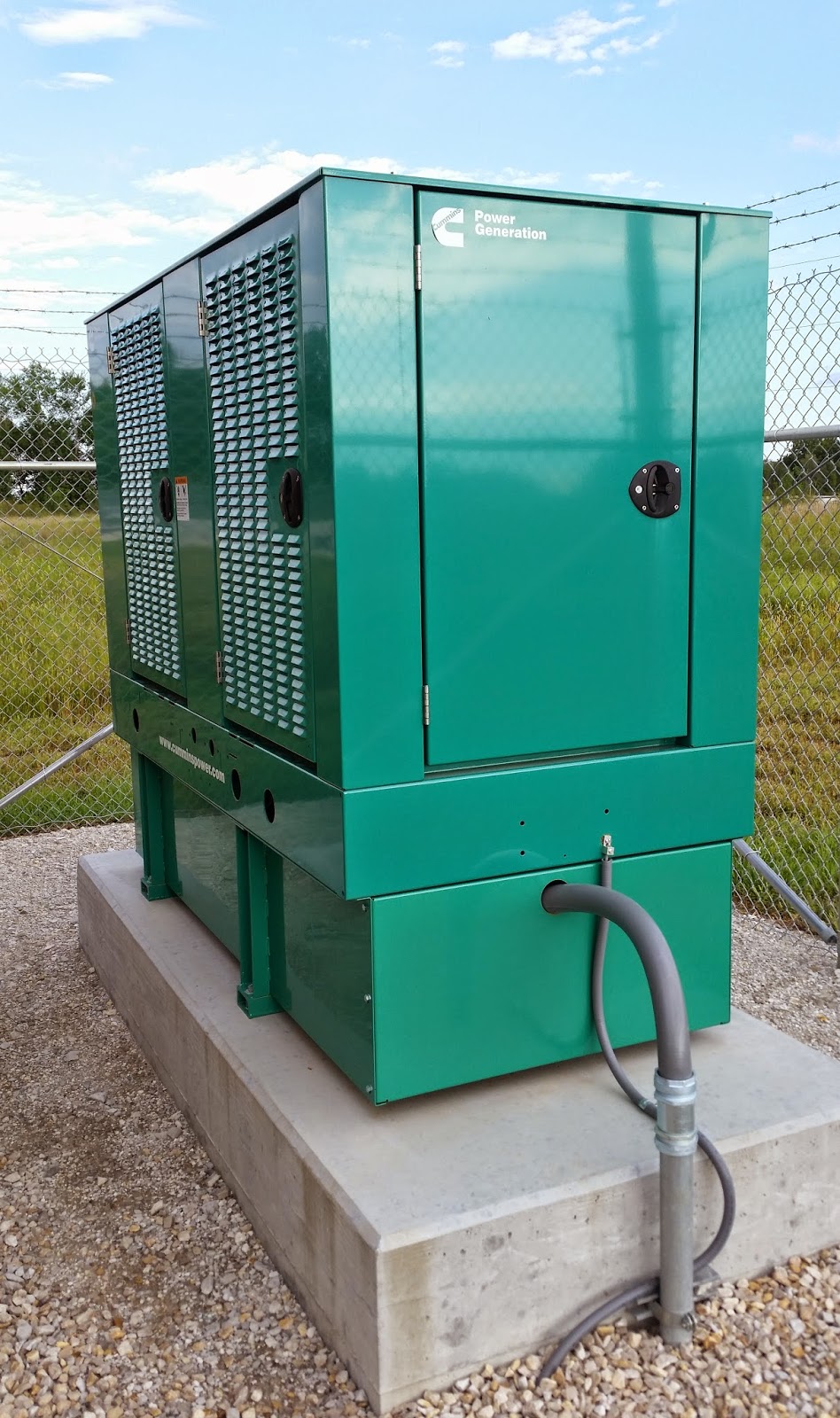 Generator is now connected. Service should now stay up even if utility power fails for up to several days.

A large underground fiber vault. Labeled "Communications."


A better view of another large fiber vault.
A small fiber vault.


Subscribe to:
Posts (Atom)